“We’ll intervene whenever we decide it’s in our national security interests to intervene. Get used to it, world—we’re not going to put up with nonsense.”
– Duane Clarridge, former CIA senior operations officer
In a blog from 2024, I discussed the frequently-cited political science witticism that no two democratic nations have gone to war with each other in modern history. I took issue with the implication that authoritarianism in other nations is the primary driver of violence in the world, given that few dictators survive without U.S. support. However, reading back, I think I spent too long on some rather oblique points.
In light of the U.S.’s recent attack on Venezuela, its threats to annex Greenland, and its continued support of genocide globally ($20+ billion in military aid to Israel since October 7, 2023; over $1 billion in arms to the UAE, who are currently supporting a group in Sudan the U.S. has charged with genocide), I wanted to revisit the claim, this time focusing on a different set of issues. I’ve divided it into two sections: one about war, and one about democracy.
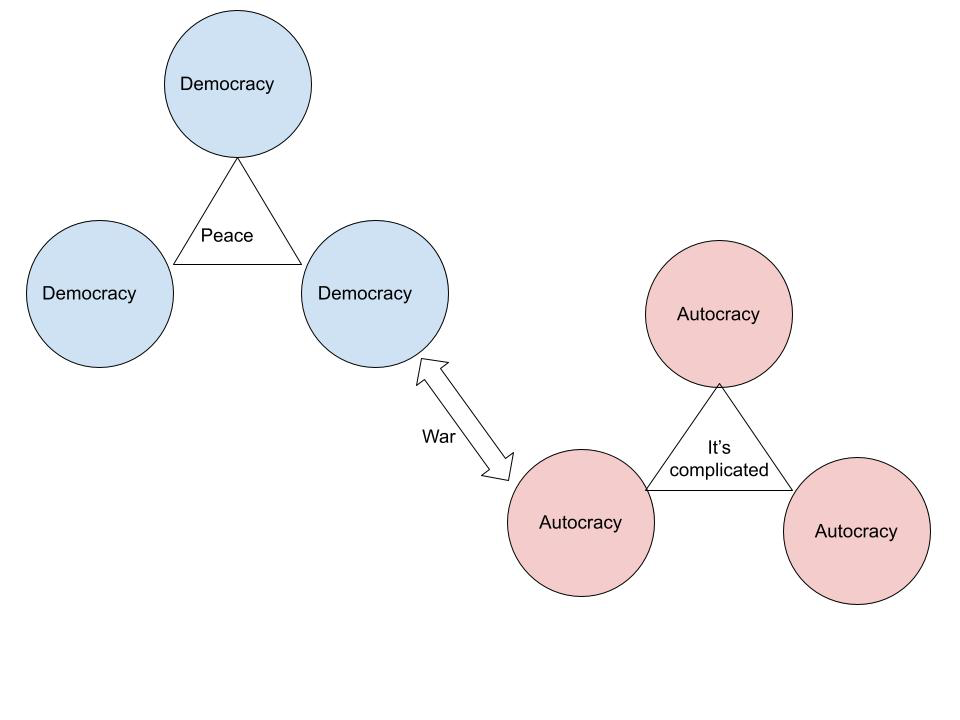
1. War is not the only form of organized violence
Global politics can be complicated, so let’s start with another catchy poli-sci factoid: the U.S. spends more on its military than the next ten countries combined. And it isn’t for nothing—the U.S. has invaded or bombed 30 countries since the end of WWII, more than any other country in the world. According to Brown University, nearly 500,000 civilians were killed by direct violence in Iraq, Afghanistan, Syria, Yemen, and Pakistan between 2001 and 2023, with an estimated 3.6-3.8 million killed indirectly in post-9/11 war zones. The U.S. also maintains over 750 military bases in 80 countries worldwide, making it a textbook example of an empire. This simple litmus test shows us that an absence of formal declarations of war does not equal peace.
This is a problem because Democratic Peace Theory, as it is known, rests on a rather fragile opposition between peace and outright declarations of war. Invasions, occupations, sanctions, and bombing campaigns are excluded entirely, even if they decimate civilian populations. It seems that the spirit of Democratic Peace Theory might better be captured by the statement, “Democracies do not engage in organized violence,” which is quite another can of worms. Democracies fund, organize, and support authoritarian governments, terror groups, and violent non-state actors all the time. Democracies’ support for these groups has nothing to do with their commitment to freedom or human rights, and everything to do with their geopolitical utility.
A prime example of this is U.S. foreign policy during the Iran-Iraq war, which took place from 1980 to 1988. During the war, the U.S. considered Saddam Hussein a strategic ally for containing the Iranian revolution, and sold Iraq billions of dollars in dual-use technology. This support continued with American officials’ full knowledge of Hussein’s use of chemical weapons, including on Iraqi civilians. But the U.S. turned a blind eye to his war crimes, helping Iraq with special operations training, intelligence gathering, and direct economic aid. Despite this, the U.S.’s goal was not Iraqi victory. As former Secretary of State Henry Kissinger put it, “it’s a pity both sides can’t lose.” Well, we did our best to make sure they both did. In the now-infamous Iran-Contra Affair, the U.S. covertly sold arms to Iran at the same time as it supported Iraq. Obviously, this contradicted the billions of dollars we committed to Iraq and mucked our admirable attempt to, just this once, not give guns to countries on our State Sponsors of Terrorism list. To be fair, this was perhaps too much to expect from a country that was already aiding a known war criminal.
But it gets worse. The “Affair” is so notorious because the CIA used the profits from arms sales to Iran to fund rebels (Contras) against—you guessed it—a socialist revolution in Latin America. The whole reason Reagan had to do this through back channels was that the Contras’ human rights abuses—including peeling off the faces of parents in front of their children—became public knowledge, leading Congress to block the CIA from funding activities in Nicaragua. But this didn’t stop the Executive branch, which simply funded our “Psychological Operations in Guerrilla Warfare” in Nicaragua by selling weapons to Iran’s Fundamentalist government.
The U.S.’s alliances with terrorists continue to turn on a dime, such as two months ago, when Washington welcomed former al-Qaeda commander Ahmed al-Sharaa, previously detained by U.S. forces for five years, to the White House. In a truly touching moment of solidarity between war criminals, former CIA director David Petraeus asked al-Sharaa if he was getting enough sleep at night. In some ways, the move to diplomacy is sincerely commendable, but recall that the Pentagon threw 1.8 trillion dollars at Iraq and Syria from 2003 to 2023. Twenty-three years and a million deaths later, welcoming a once-jihadist to the White House demonstrates that the very accusation of terrorism is a reflection of the U.S.’s geopolitical interests more than a group’s actual activities.
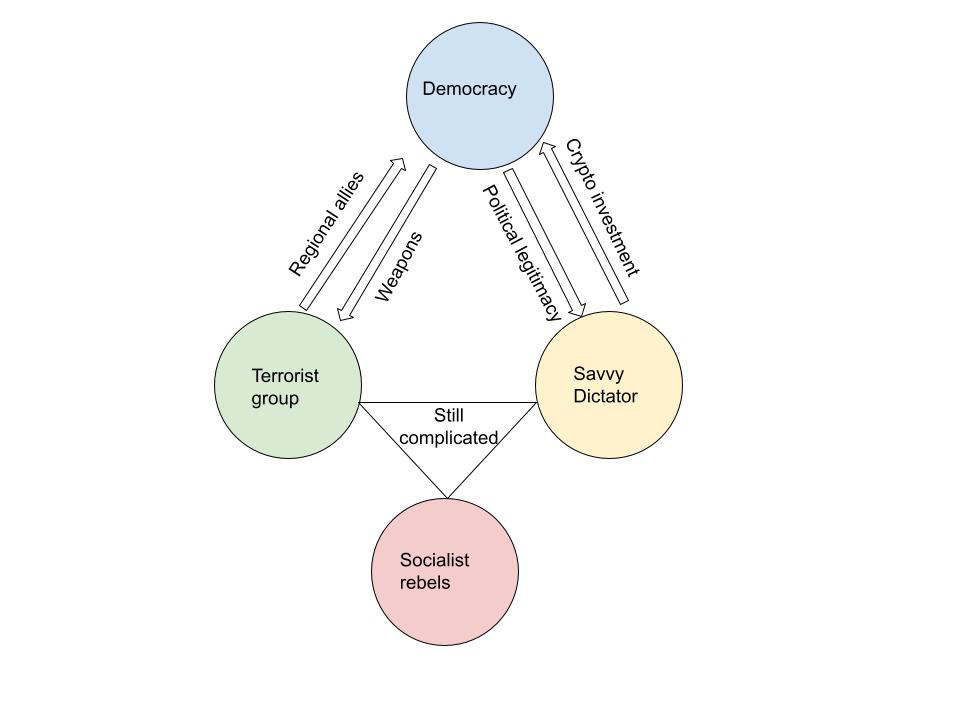
Clearly, the U.S. likes to keep its feet in many camps. And while Democratic Peace Theory paints non-democratic governance as the main cause of global conflict, the opportunistic tentacles of American empire demonstrate that alliances between excessively violent regional powers and global superpowers are ubiquitous, changing constantly based on underlying economic and geopolitical interests. Imperialist states—democratic or otherwise—have been actively arming and supporting terrorists, authoritarians, and violent non-state actors for decades, actively instigating and prolonging some of the most atrocious conflicts in the post-war era.
But could this just be temporary? After all, maybe once everyone else is also a democracy, there will be no more need for the U.S. to play the global police officer. It’s a nice idea, but it misses the point: in many parts of the world, the U.S. playing global police officer is the obstacle to democracy. However, there’s one thing that Democratic Peace Theory seems to get right, and that is the direction of global conflict. That is, organized violence between democracies seems to be relatively rare, even if First World empires bully the Third World every day of the week. And this brings us to the problem of the term democracy.
2. Democracy’s baggage
In its own distorted way, Democratic Peace Theory correctly observes that organized violence often takes place between blocs of nations that share certain important features like colonial status, level of industrialization, and mode of governance. But governance (democratic/undemocratic) is just one way of categorizing these blocs. Another is First World and Third World. Or debtors and creditors. Or industrialized and non-industrialized. Oppressor and oppressed. Militarized and un-militarized. Developed and developing. Core and periphery. These categories aren’t all equivalent, and none of them is perfect, or even particularly helpful. They’re just narrow ways of dividing an extraordinarily complex world.
But surely ranking countries against the liberal democratic ideal gets us somewhere, right? Sure: the world has developed an industrial core with sites of raw material extraction, and these respective regions share important histories. The problem with Democratic Peace Theory is that it uses one word to conceal a myriad of unequal developments—colonialism, slavery, industrialization, debt and financialization, rare earth mining and fossil fuel extraction, etc.—that have allowed certain regions to enjoy peace and prosperity. Actually, it’s not even that these regions have particularly enjoyed peace, as much as organized violence has worked to their benefit.
To show how the logic of Democratic Peace Theory can go wrong, I want to look at far-right commentator Ben Shapiro, who makes the argument that Scandinavian countries are so peaceful compared to the U.S. because their lack of racial diversity makes it easier for everyone to get along. This statement is false for several reasons, but Shapiro does understand—correctly—that people of different colors experience different social realities and life outcomes. His misstep is in saying Blackness is an inherent source of violence, rather than the social-legal system that creates both Black/white-ness and differential social outcomes based on Black/white-ness. Shapiro confuses the institutions and practices that produce Blackness—slavery, segregation, divestment, red-lining, racist policing and incarceration, etc.—for “Blackness itself.”
In my view, “whiteness” for Shapiro is analogous to “democracy” for Democratic Peace Theorists because both terms are unmarked. Race theorists have, for a long time, commented on how whiteness operates as the “default” race and, in doing so, obscures the oppressive social systems that both produce and privilege whiteness. Democratic Peace Theory similarly imagines democracy as an unmarked, uncontroversial way of being from which violence is absent. However, there are a multitude of systems at work behind the democratic nations we see today. Namely, we are talking about post-industrial, colonial, imperialist, bourgeois democracy. When we say “democracy is more peaceful,” we hide these qualifiers and therefore the organized violence that happens behind the scenes in order to produce a peaceful, unmarked image of democracy. In this way, Democratic Peace Theory infers causality from one feature of a privileged social group, ignoring the underlying systems that produced both the social group and the dynamics that privilege them.
The notion that democracies are generally pacific nations puts in our mind the idea of war-mongering autocracies that instigate conflict around the world. However, as we’ve seen, the opposite is true: for the U.S. and much of Western Europe, stimulating, fanning, and straight-up fabricating organized violence is part and parcel of their domestic peace. In fact, in War Making and State Making as Organized Crime, sociologist Charles Tilly sustains that governments are upheld by creating threats and then charging their citizens for protection against them. He explains:
“To the extent that the threats against which a given government protects its citizens are imaginary or are consequences of its own activities, the government has organized a protection racket… since the repressive and extractive activities of governments often constitute the largest current threats to the livelihoods of their own citizens, many governments operate in essentially the same ways as racketeers.”
Cue the U.S. sending billions of dollars to Saddam Hussein and then proceeding to spend 20 years fighting a war on terror. But whether or not you agree that modern states are militarized racketeers, the fact is that organized violence is largely funded by and beneficial to industrialized, imperialist First-World nations, many of which are electoral democracies. Even in cases of highly complex and sustained internal conflicts, such as in the DRC and other formerly colonized, resource-rich countries, the fingerprints of now-democratic nations are all over. And for good reason: these internal conflicts reap juicy profits, whether from the perspective of an arms dealer, energy company, or jewelry manufacturer. Unfortunately, free and fair elections do not preclude governments from securing their—or their corporations’—piece of the pie, even when it means backing war criminals and narco-traffickers, carrying out military coups, and training terrorists, which some do regularly.
To conclude, I want to say that the reason Democratic Peace Theory rubs me the wrong way is that it feels like a fundamentally uncurious way to understand how, and in whose benefit, organized violence works in the world today. When I hear the sentence, “No democratic nations have gone to war with each other in modern history,” it feels like doing a moral victory lap, as if today’s democracies weren’t the cruelest slave-owning, hand-chopping, drug-dealing, colonial monarchies just a few generations ago. And as if those histories had no bearing on our countries’ relative prosperity in the world today. To quote my last blog: “It seems that democracy, as it applies to modern nations, is a privilege of ‘winning’ globalization more than an ethical milestone as a society.”
Until next time,
Lucas