On the eve of Ramadan, my friend Yassine and I sat on his couch, anxiously watching the TV. A news segment with the sterile, waxy sheen typical of Arabian Gulf propaganda showed Saudi sheiks making lunar observations with precision telescopes. They were looking out for the first sliver of moon in the sky, which would commence the month of Ramadan—but as 9 pm Tunisia Time rolled around, no one was yet sure whether the sliver would appear.
For Yassine and me, a lot was at stake. We had just arrived at his family’s home in Kairouan, the fourth-holiest city in Islam (a little-known fact, much to the dismay of Kairouanians), with a full day of activities planned. If the sky remained dark tonight, we would have all of tomorrow to drink coffee, try the city’s famous lunch dish, kefteji, and enjoy the city’s vibrant daytime energy. On the other hand, if the smallest slice of the moon appeared in the eye of a Tunisian telescope, we would start fasting from sunup to sundown, and all of the restaurants in the city would be closed during the day.
Up on the International Space Station, where sunup and sundown occur sixteen times every 24 hours, Muslim astronauts pray according to the schedule issued in a 2007 fatwa, whose production drew over 150 Muslim legal scholars. The scholars wrote that, to perform the five daily prayers, Muslims in space should follow the time zone of the place they left Earth and “should face Mecca if possible; but if not, they could face the Earth generally, or just face ‘wherever.’” I thought that sounded reasonable.
Down on Earth, the TV switched to a man reading slowly from a small pile of papers. According to Yassine, he was the highest religious figure in Tunisia, and he was making a long-winded preamble before announcing the start date of Ramadan. Saudi Arabia had already declared their Ramadan would begin tomorrow, which did not bode well for us, since Tunisia typically follows its lead. But since Ramadan depends on a local moon sighting, there was still a chance we would hold out. Finally, the man finished his throat-clearing and announced that Tunisia would not follow the Gulf—Ramadan was delayed another day.
After a long night of rest, we indulgently re-celebrated the eve of Ramadan with kefteji and a coffee, and then headed off to Okba Mosque, the oldest mosque in the Maghreb. It was originally built in 670 AD, only to be destroyed by Indigenous Berbers twenty years later, and then rebuilt in 703. Two things struck me about the courtyard: first, its many columns varied widely in style. Some of their capitals—the decorative parts at the top—were even reminiscent of the ruins at ancient Carthage, a three-hour drive away.
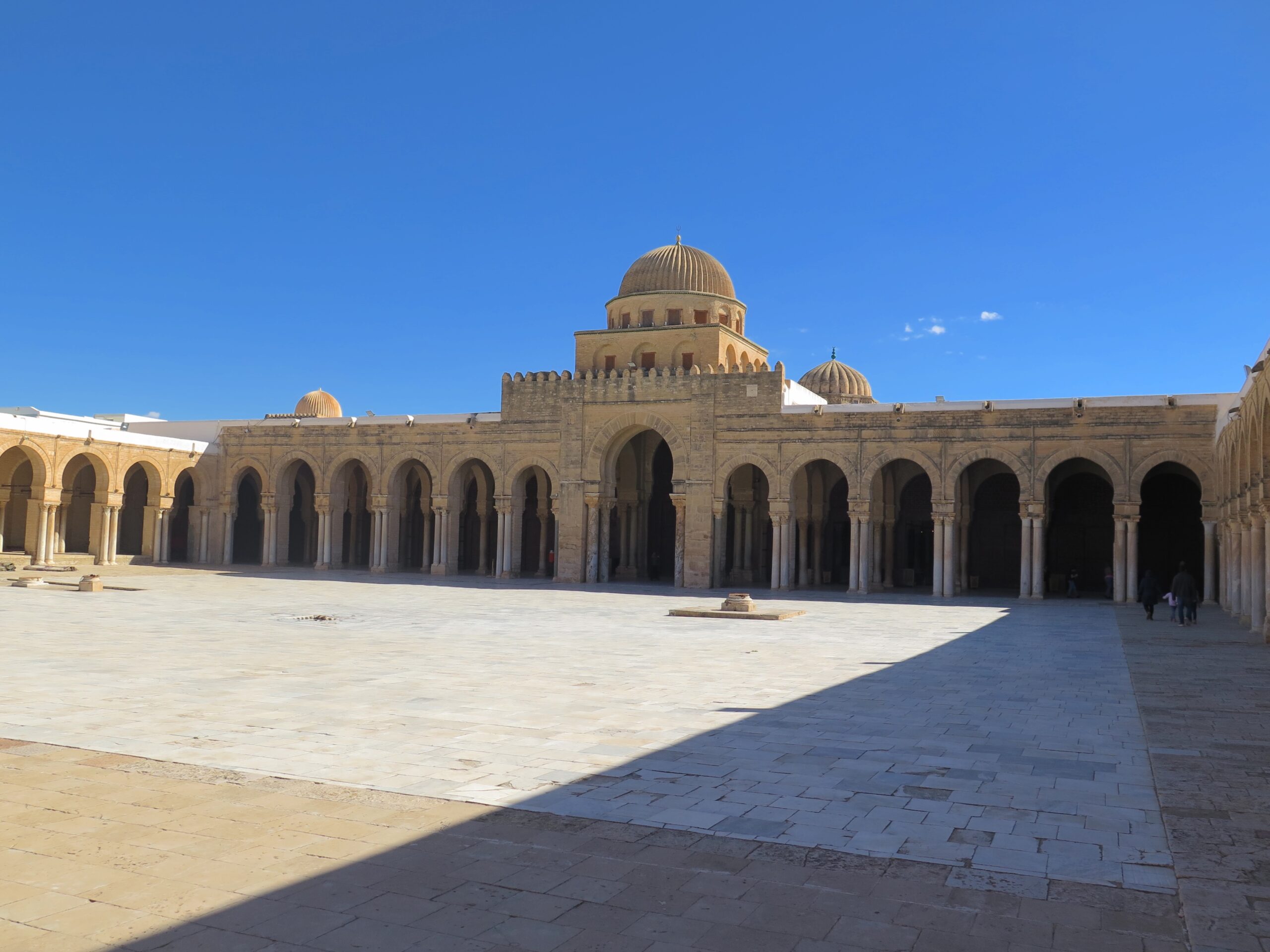
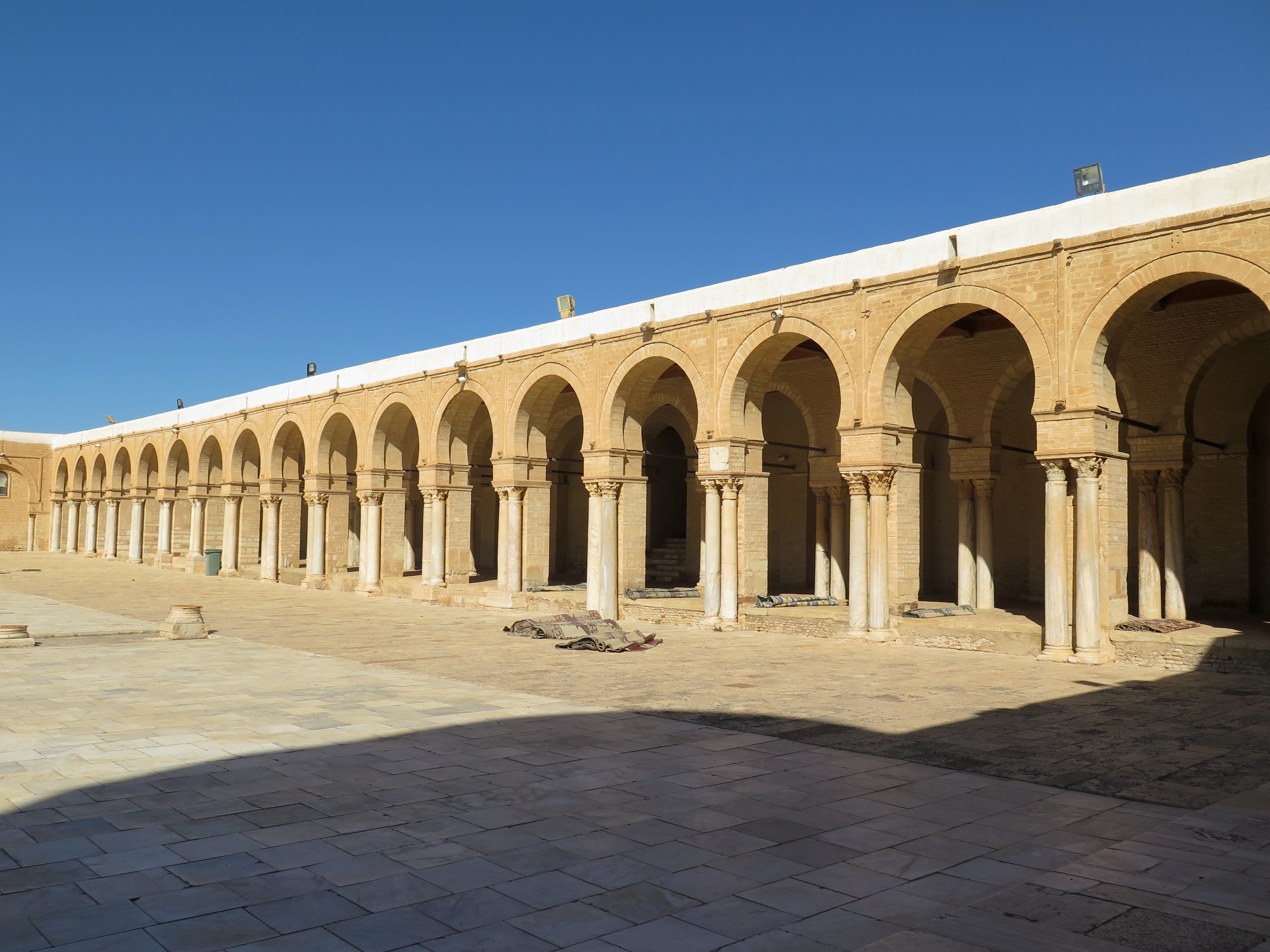
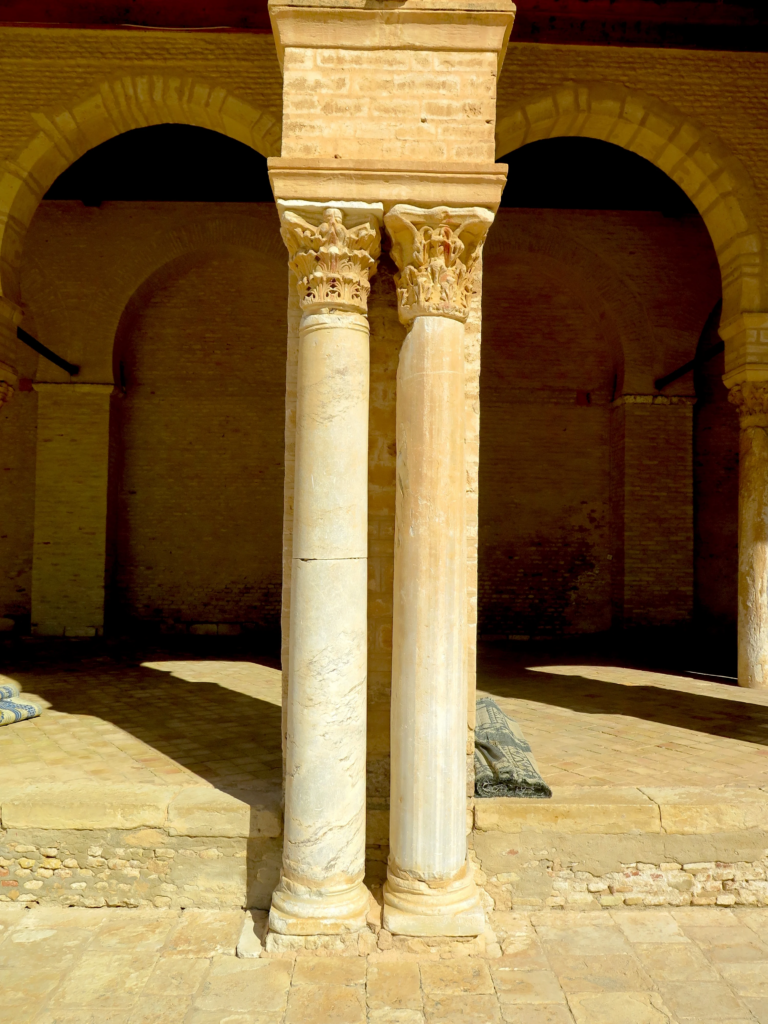
I commented on this to Yassine, who told me that many of the columns were indeed brought from other ancient sites in the country, including Carthage. I loved standing in the middle of the courtyard, admiring that the building—already one of the oldest places of Islamic worship—was itself a motley construction from even more ancient Roman, Byzantine, and Carthaginian buildings.
But there was just one little fracture in the immersive scene: a set of stairs, apparently leading nowhere, smack dab in the middle of the courtyard.
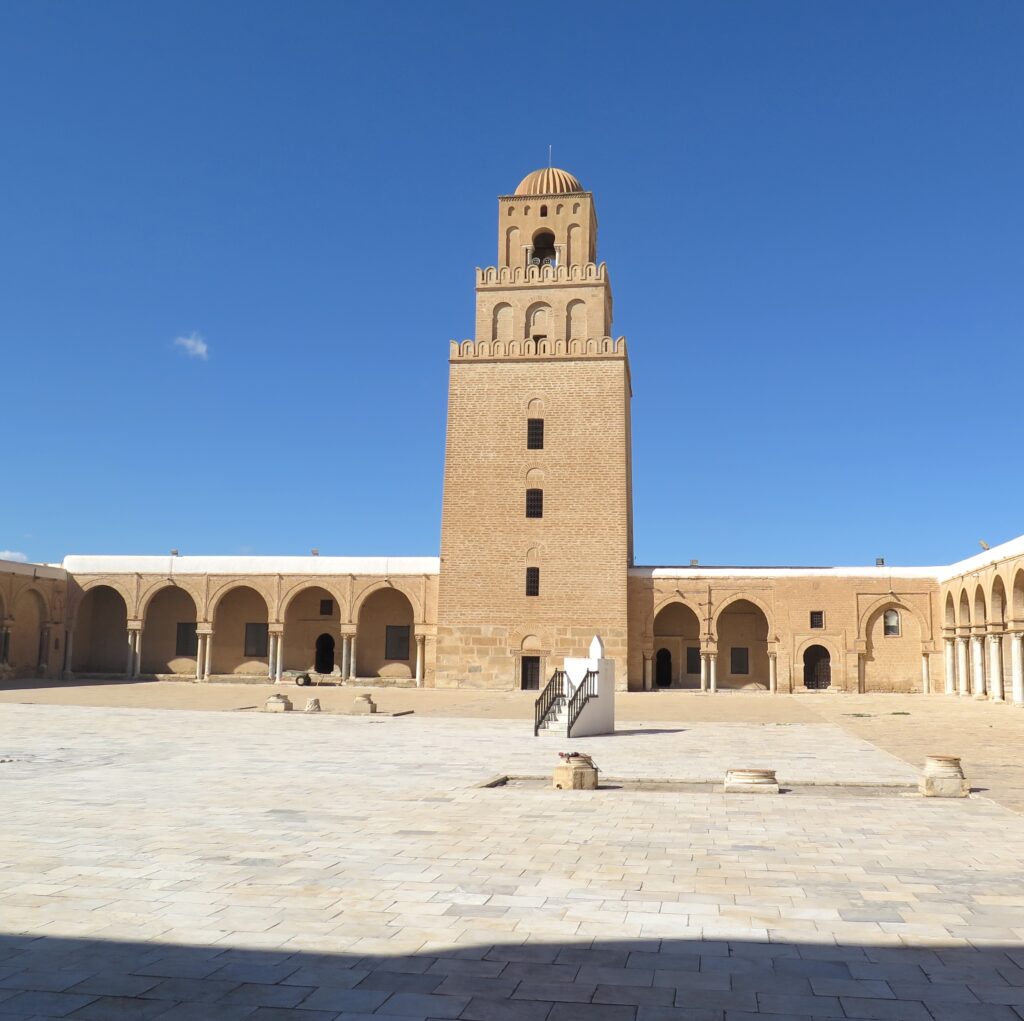
I accepted this odd, intrusive feature of the landscape without a second thought, but it wasn’t long before I regretted my disinterest. A couple of days later, while watching a vlog Yassine made about the mosque, I spied a cryptic-looking sundial. “Where was that?” I asked. It turned out that the stairs led to a mizwala, an ancient device for calculating the times and direction of the five daily prayers.
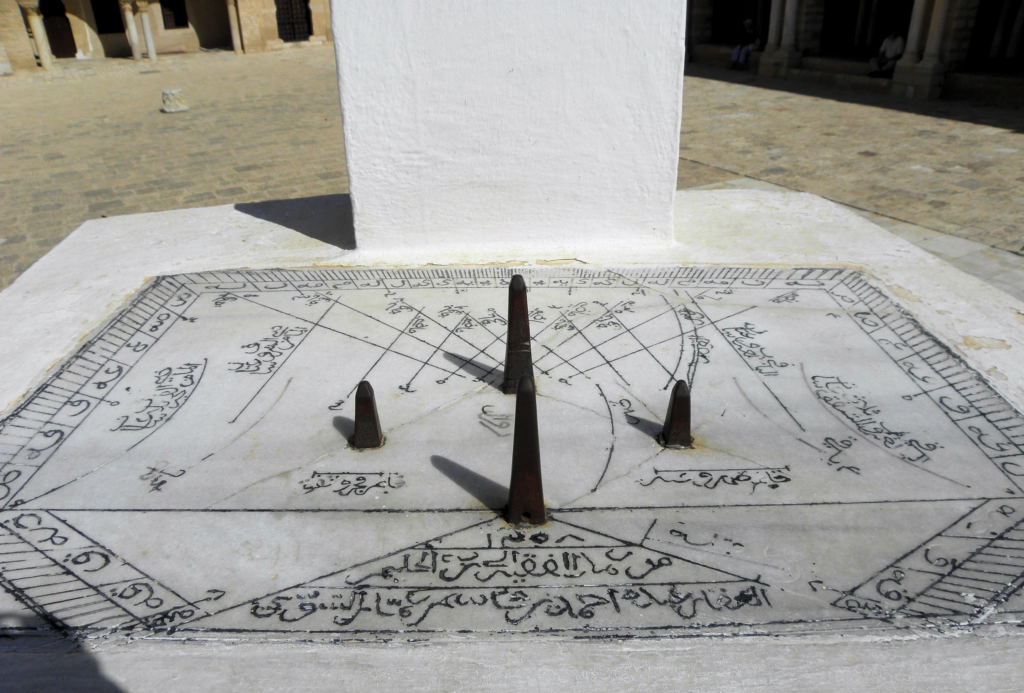
Admiring the elegant but mysterious (to me, anyway) curves on the sundial, I was reminded of the navigational tools at a Portuguese naval museum I visited a few months before.
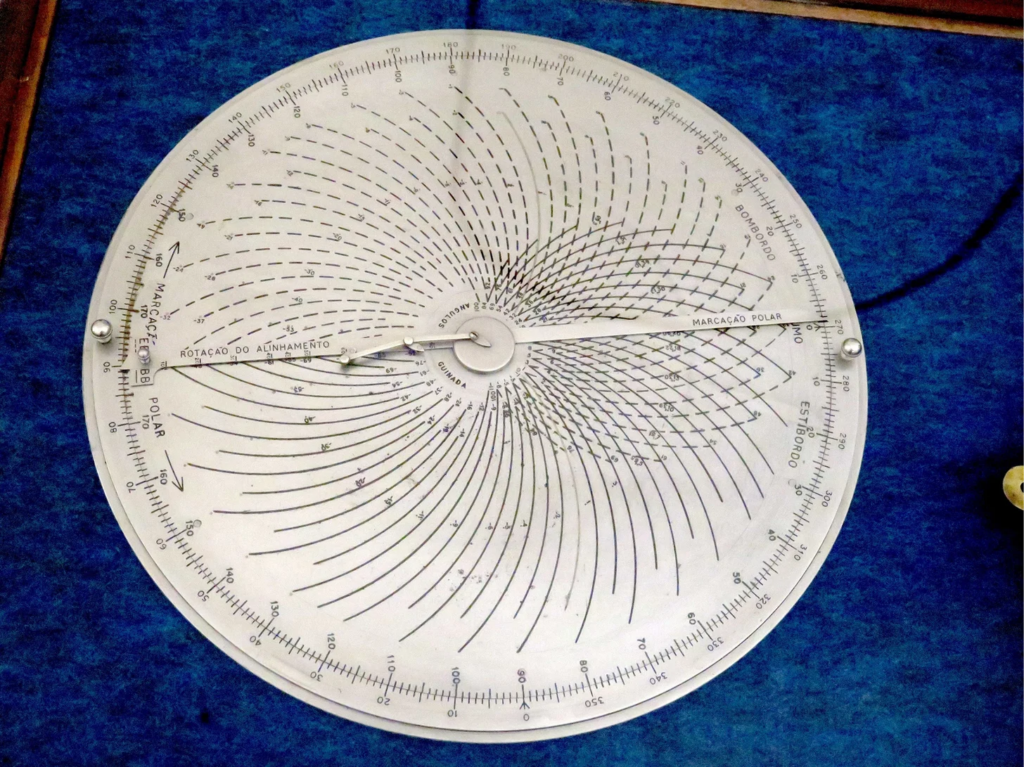
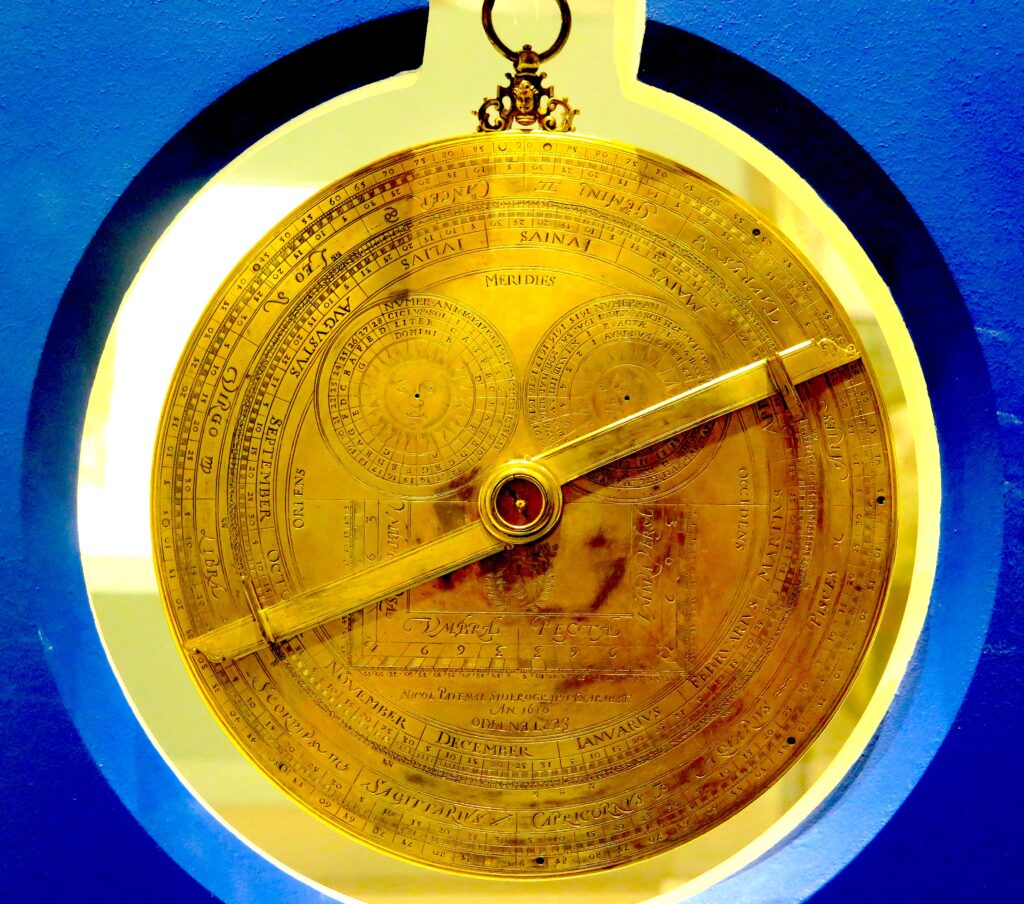
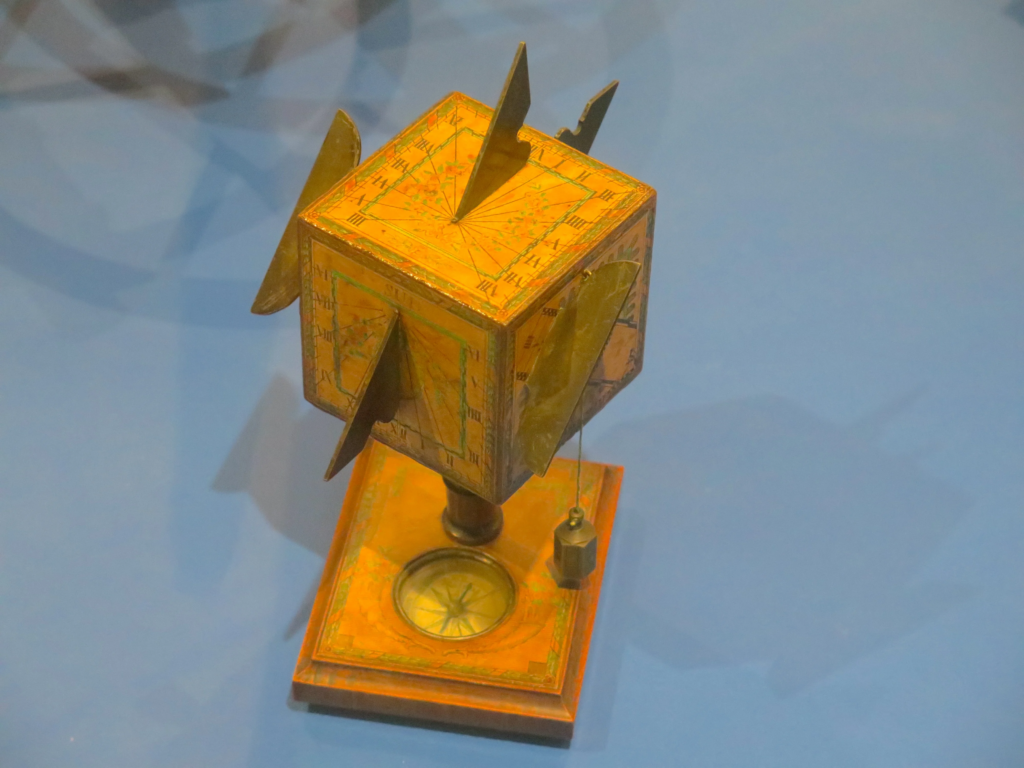
The theoretical foundations of European seafaring technology were developed extensively by Muslim scholars, particularly through their work on tools like the mizwala. For instance, from the 9th to 14th centuries, Muslim astronomers and mathematicians developed rigorous methods of spherical trigonometry to calculate the Qibla, or direction of Mecca, from almost anywhere on Earth. Al-Khalīlī, a 14th-century astronomer from Damascus, even compiled a Qibla table of over 3,000 entries for different latitudes and longitudes, with an accuracy comparable to modern techniques. The principles of spherical trigonometry were fundamental for later European navigational developments, which were, of course, pursued with their own religious goals in mind.
In addition to navigation technology, the intertwined roots of astronomy and religion are also present in calendar systems, which weave time, mathematics, and spirituality across vastly different societies. One of my favorite examples of this is the Mayan calendar, whose progression is often depicted using three interlocking wheels. The three calendars synchronized the Mesoamerican society’s agricultural practices, rituals, and even day-to-day planning, depending on their alignment.
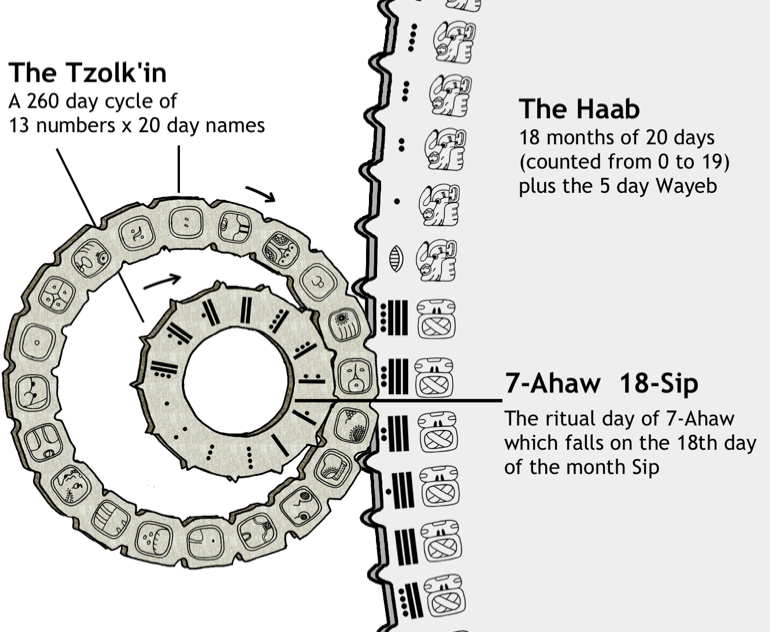
Some may remember that, in 2012, a misinterpretation of this calendar caused widespread panic about a cataclysmic event that would supposedly take place on December 21st. It’s interesting to note that, although a Mayan from 500 BC and a 2012 #doomsdayer inhabit completely disparate cosmic universes, the ancient calendar became imbued with a distinctly 21st-century apocalypticism. For a brief flash, our Gregorian wheel was no longer the center of Time. Would our calendar, a mere 400 years old, fracture as the tectonic plates of a more ancient time wheel shifted beneath us?
Apparently not. But during the Rapture That Never Was, it certainly became clear how deeply we rely on calendars for spiritual grounding. On one hand, it’s easy to see that recurring anchors like holidays, memorials, and seasonal vacations tether social life to our solar system and a sense of historical time. But for many, the idea of an End Time—even a violent, chaotic, or absolute one—is also a core source of spiritual identity, alongside a garden variety of creation myths and cyclical repetitions.
The nearly intrinsic link between calendars and religion makes me all the more bewildered by the use of CE (Common Era) as a more “respectful and secular” alternative to AD (Anno Domini, “year of our Lord” in Latin) in the Gregorian calendar. Mostly because, even if we change our era’s name, “Year 1” in the calendar still denotes the birth of Jesus Christ. And why shouldn’t it? Christ was the central religious figure of the societies that first adopted the Gregorian calendar and proceeded to conquer most of the world, making it the dominant calendar system today. By changing the name, we don’t become less Christ-centric, but we do get to pretend the whole World Domination in the Name of Our Lord thing didn’t happen. So, I declare: Own up, secularists! No more hiding from the impending religious pillars of Western society! It is 2026, Year of Our Lord!
Upon returning from Kairouan, I enjoyed a lovely moment of calendric alignment: the Hindu festival Holi fell on the same day as the halfway point of Ramadan, a full moon. My friend, who plays Dhrupad, the oldest surviving form of Indian Classical music, put on a small concert (perhaps listening experience would be more apt) for us to enjoy and relax in the spirit of Krishna, whose playful spirit is celebrated during Holi.
In the spirit of this blog’s apparent theme that Time is Just a Social Construct, Bro, I now realize I’m sending it out a week late. Ah, well. Up and onwards, through our Linear Gregorian plane.
Until next time,
Lucas